
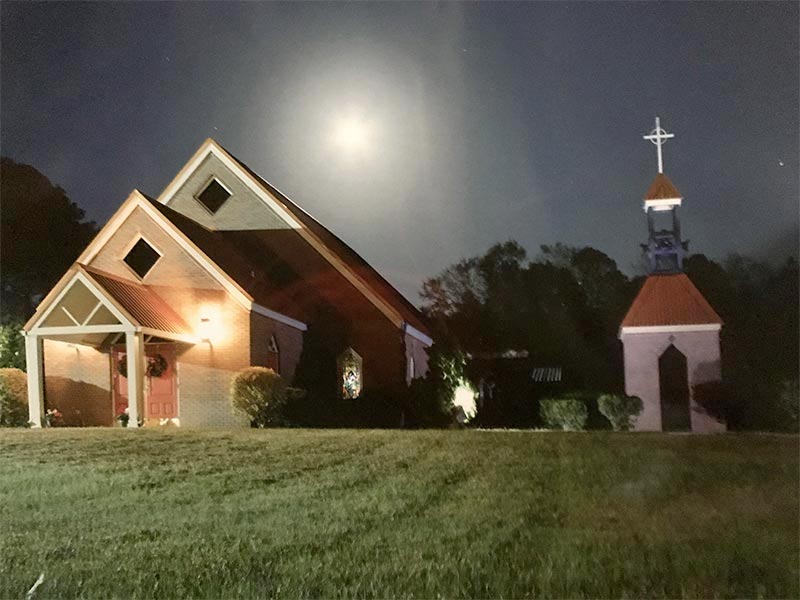
St. Pierre's Episcopal Church Gautier, MS


Parish News

St. Pierre's/Gautier Easter Service Schedule

March 24, 2026

St. Pierre's/Gautier Holy Week and Easter Service Schedule 2026


March 29, Palm Sunday, 9:00 a.m.

April 2, Maundy Thursday, 5:30 p.m.

April 3, Good Friday, 5:30 p.m.

April 4, Easter Vigil, 6:30 p.m.

April 5, Easter Sunday, 9:00 a.m. 

The Mississippi Episcopalian

St. Pierre's/Gautier Easter Service Schedule

March 24, 2026

St. Pierre's/Gautier Holy Week and Easter Service Schedule 2026


March 29, Palm Sunday, 9:00 a.m.

April 2, Maundy Thursday, 5:30 p.m.

April 3, Good Friday, 5:30 p.m.

April 4, Easter Vigil, 6:30 p.m.

April 5, Easter Sunday, 9:00 a.m. 

February Grapevine

February 04, 2026

St. John's Episcopal Church-Ocean Springs

The Grapevine, the monthly newsletter of the parish of St. John, Ocean Springs, is available online.

Monthly Newsletter

For November 2025

October 30, 2025

St. John's Episcopal Church-Ocean Springs

The Grapevine in available online.

Daily Office Online

August 22, 2025

St. John's Episcopal Church-Ocean Springs

St. John's: a community at prayer. Come pray with us.

8:00 a.m. Morning Prayer (bulletin) (join on Zoom)

12:00 p.m. Noonday Prayer (bulletin) (join on Zoom)

4:00 p.m. Evening Prayer (bulletin) (join on Zoom)

8:00 p.m. Compline (bulletin) (join on Zoom)

Meeting ID: 503 801 018

Password: 047095

Never "Zoomed" before? Click here

Yoga

August 22, 2025

St. John's Episcopal Church-Ocean Springs

Yoga classes will start back on Wednesday, September 10

  • Chair yoga - 10:30 a.m.
  • Gentle mat yoga - 12:00 noon

Cherub Choir! Join us!

August 22, 2025

St. John's Episcopal Church-Ocean Springs

Wednesday afternoons from 4:30 p.m. to 5:00 p.m.  Children (K – 3) are invited to participate.  For more information contact Mary Chaffe Brooks or Jonathan Mitchell.  Cherubs sing about once every 6 weeks, usually at the beginning of the 9:00 a.m. service.

Episcopal News Service

Dallas bishop discourages use of expansive-language liturgies, favors ‘unity’ in 1979 prayer book

June 03, 2026

Episcopal News Service

[Episcopal News Service] All dioceses in The Episcopal Church regularly rely on the 1979 Book of Common Prayer to structure their worship services. The bishop of the Diocese of Dallas wants his diocese’s congregations to refrain from using any other liturgical text, at least on Sundays. Last month, Bishop Robert Price issued new guidance for Sunday liturgies in his diocese, based in Texas’ third-largest city. Effective Trinity Sunday, May 31. Price’s guidance specifically insisted on the use of “liturgies contained in the memorialized 1979 Book of Common Prayer,” and he advised congregations not to incorporate several other commonly used supplemental liturgical resources, including the church’s “expansive language” versions of Holy Eucharist Rite II and the collection of liturgies known as Enriching Our Worship. Those supplemental liturgies have been authorized for use throughout The Episcopal Church without the need to get permission from a bishop, a fact that Price acknowledged when he released revised guidance on June 2. “I am unable to prohibit the use of these prayers on Sunday mornings,” Price wrote in his latest letter to the diocese. “Nevertheless, the underlying reason for the original prohibition remains unchanged: the desire that our diocese pray together as one body using the memorialized 1979 Book of Common Prayer, thereby deepening our union in Christ.” Out of that “pastoral concern,” Price said he is asking clergy “to refrain from the use of the expansive-language versions of the Book of Common Prayer as an act of gracious restraint, sacrificial love, and fellowship with their sisters and brothers in Christ.” It isn’t clear how many of the more than 60 congregations in the Diocese of Dallas have regularly used expansive-language liturgies, though the bishop’s changing guidance has required at least one congregation to adjust. Church of the Transfiguration has used those supplemental liturgies for the past eight years. The supplemental liturgies “were intended to lessen the dependence on masculine pronouns for God, which can diminish our spiritual imaginations, and also introduce some changes to the Nicene Creed to foster ecumenical relationships,” the Rev. Casey Shobe, Transfiguration’s rector, said in a May 28 message to the congregation about Price’s initial prohibition. “As we begin this next chapter, we will abide by the bishop’s direction.” When Episcopal News Service reached Shobe by phone on June 3, he said he and other church leaders were still digesting the latest guidance from Price before deciding which liturgies to use in Transfiguration’s Sunday services. “We are certainly grateful for the acknowledgment of General Convention’s authority in the matter and grateful for the bishop’s leadership and humility in this,” Shobe told ENS. “We will take seriously his request … while also thinking very carefully about how much the expansive-language rites have meant for the parish in these last eight years.” Price has not said whether he specifically objects to the church’s yearslong development and authorization of expansive-language liturgies. In a written response to ENS’s questions, he did not comment on those liturgies. Rather, he indicated that asking all congregations to use the 1979 Book of Common Prayer on Sundays is a way to promote unity in a diverse diocese. “While a symbolic gesture, I believe that symbols matter,” Price told ENS. “We have a theological diversity in the Diocese of Dallas that no longer exists in many dioceses, and I am asking everyone to sacrifice their preferences in order to build mutual charity. To be honest, I am somewhat bemused that asking Episcopalians to use the 1979 BCP on Sunday mornings is perceived as being in any way radical or oppressive.” If not radical or oppressive, Price’s guidance appears to be unusual. The Rev. Ruth Meyers, a prominent scholar of the church’s liturgical history, told ENS that some bishops had forbidden the use of such supplemental liturgies while those liturgies were still being developed, but since they were fully authorized by General Convention in 2018  she was unaware of a bishop openly discouraging their use. Meyers, a longtime General Convention deputy and a retired Church Divinity School of the Pacific liturgics professor, also questioned whether a call for “unity” justified exclusive use of the 1979 Book of Common Prayer. “The unity would be at the churchwide level, not at the diocese level,” Meyers said, since it is up to General Convention to determine what liturgies are authorized for use in the church’s dioceses and congregations. Price, in his statement to ENS, said the inspiration for the new guidance dates to the time before he was elected bishop when he was meeting with local leaders. “Building greater trust and collegiality amongst the clergy and parishes of the diocese was identified as a key priority of the new bishop, and I have sought to facilitate that healing and deeper unity in ways great and small since my consecration,” he said. “As a part of that effort, I have put forward pastoral guidance that seeks to bring all of us together.” The bishop’s new guidance follows decades of debate within The Episcopal Church and across the Anglican Communion about the role that “common prayer” plays in Anglican unity. Meyers underscored that the consensus over time has shifted away from a unified text in favor of a set of shared principles, approaches and structures in Anglican and Episcopal liturgies. The Book of Common Prayer was first published in 1549 for use in the Church of England, and in subsequent centuries, it became the primary liturgical text for Anglicans worldwide in the provinces of what is now known as the Anglican Communion. In 1958, the Lambeth Conference of Anglican bishops acknowledged that independent liturgical revisions in those autonomous provinces, including The Episcopal Church, had made it harder to agree on one single text. In response, the Lambeth Conference called attention “to those features in the Books of Common Prayer which are essential to the safeguarding of our unity: i.e., the use of the Canonical Scriptures and the Creeds, Holy Baptism, Confirmation, Holy Communion, and the […]

Read full article →

Young people invited to join second ‘e-cumenical’ youth gathering

June 03, 2026

Episcopal News Service

[World Council of Churches] The World Council of Churches Young People in the Ecumenical Movement will host its second online gathering on June 10 via Zoom. Young ecumenists worldwide are invited to meet, share experiences and strengthen relationships across regions. Building on the momentum of the first virtual gathering held in 2025, the 90-minute event will provide opportunities for informal conversation and mutual learning through regional breakout groups. Participants will also receive an introduction to the YPEM Global Collective and its ongoing efforts to connect and empower young people within the ecumenical movement. Read the entire article here.

Read full article →

World Council of Churches co-organizing conference on building interreligious relationships in Europe

June 02, 2026

Episcopal News Service

[World Council of Churches] The World Council of Churches, the Vatican’s Dicastery for Interreligious Dialogue and a broad coalition of Christian and Dharmic partners are co-organizing an international conference aimed at strengthening fraternity, dialogue and collaboration among religious communities in Europe. The conference, titled “Buddhists, Christians, Hindus, Jains, and Sikhs in Europe: Building Fraternity through Dialogue and Collaboration,” will take place June 23-24 at St. Thomas Aquinas University in Rome. Religious leaders, scholars, peace activists, academics, students and others from across Europe will participate. Read the entire article here.

Read full article →

Episcopalians called to ‘Vote Faithfully’ as church renews, expands election engagement efforts

June 02, 2026

Episcopal News Service

[Episcopal News Service] The Episcopal Church is kicking off its “Vote Faithfully” voter engagement efforts for the 2026 midterm elections with a series of online events to educate Episcopalians on nonpartisan ways they and their congregations can support civic participation in their communities. The half-hour networking calls on Zoom, organized by the church’s Public Policy and Witness team, are scheduled for 1:30 p.m. Eastern on June 4, July 2, Aug. 6, Sept. 3, Oct. 1 and Nov. 5. Registration is available here. The first call, on June 4, will feature Chief Legal Officer Kent Anker and a discussion of IRS rules for nonpartisan advocacy by religious organizations. Other calls will offer guidance on a range of topics, including voter registration efforts and election awareness campaigns, in which Episcopal congregations can serve as trusted sources for reliable information, said Allison Duvall, senior manager of church relations and engagement. Duvall, in an interview with Episcopal News Service, noted that the upcoming 250th birthday of the United States — marking the signing of the Declaration of Independence on July 4, 1776 — also has relevance for The Episcopal Church, which was founded in the same era when Anglicans in the newly independent states broke away from the Church of England. “One of the most important ways we can show a healthy patriotism is by helping our neighbors exercise their democratic right to vote,” Duvall said. The church’s online networking series is just one of the ways that Episcopal leaders are encouraging greater involvement in the democratic process. For several years, the Washington, D.C.-based Office of Government Relations has compiled, updated and expanded a selection of voter engagement resources that can be tailored to local efforts across the country. “We recognize election engagement as an act of Christian stewardship and a tangible way to love our neighbors,” the Office of Government Relations says on its election engagement webpage. “Our mandate to care for God’s world and people compels us, morally and spiritually, to vote—and to help ensure voting access for others.” The guidance includes ways to register to vote, find polling places, request an absentee ballot and volunteer as a poll worker. Congregations also have a variety of options for getting involved, including assisting in voter registration efforts, offering childcare on Election Day, organizing rides to the polls, educating voters about new state election procedures and combatting disinformation about elections. “A lot of the resources we’ve pulled together we’ve done in partnership with other faith organizations,” such as Interfaith America, Alan Yarborough, director of government relations, told ENS. By “leveraging the church as a trusted voice,” Episcopalians can share basic information in their communities with greater confidence. “Accuracy in information is just so critical,” Yarborough said. The Office of Government Relations, through its Episcopal Public Policy Network, also has been vocal in rallying Episcopalians to the cause of greater voter access, especially after the U.S. Supreme Court further weakened the Voting Rights Act of 1965 in an April 2026 ruling that all but removed protections against racial gerrymandering of congressional districts. “To bolster democracy in the United States, we in The Episcopal Church call for an expansion of voter registration, protection of voter eligibility and making the voting processes more accessible,” the EPPN said in an action alert after the Supreme Court ruling. “We oppose efforts that undermine democratic processes, including legislation like the SAVE America Act, which would limit access to the polls by implementing overly restrictive voter ID requirements, thus disenfranchising millions of eligible voters.” The action alert and the church’s election engagement resources include a summary of the history of The Episcopal Church’s positions on voting rights, as adopted by General Convention and Executive Council. “To some extent, this is work that’s been going on for generations,” Yarborough said, and The Episcopal Church is not alone. “There are many examples of faith organizations that do this well.” – David Paulsen is a senior reporter and editor for Episcopal News Service based in Wisconsin. He can be reached at dpaulsen@episcopalchurch.org.

Read full article →

Fiji churches concerned over increasing reports of missing children

June 02, 2026

Episcopal News Service

[World Council of Churches] The Fiji Council of Churches expressed deep pastoral concern over the increasing reports of missing children between the ages of 13 and 16 in the South Pacific archipelago. “As churches, we mourn with families living with fear, uncertainty, and heartbreak during these difficult moments,” it said in a statement. “Our children are precious gifts from God, entrusted into our care, protection, and love.” The churches underscored the urgent need to strengthen homes, communities, and support systems so that young people may feel safe, heard, valued and guided. Read the full article.

Read full article →

St. Pierre's/Gautier Easter Service Schedule

March 24, 2026

St. Pierre's/Gautier Holy Week and Easter Service Schedule 2026


March 29, Palm Sunday, 9:00 a.m.

April 2, Maundy Thursday, 5:30 p.m.

April 3, Good Friday, 5:30 p.m.

April 4, Easter Vigil, 6:30 p.m.

April 5, Easter Sunday, 9:00 a.m. 

February Grapevine

February 04, 2026

St. John's Episcopal Church-Ocean Springs

The Grapevine, the monthly newsletter of the parish of St. John, Ocean Springs, is available online.

Monthly Newsletter

For November 2025

October 30, 2025

St. John's Episcopal Church-Ocean Springs

The Grapevine in available online.

Daily Office Online

August 22, 2025

St. John's Episcopal Church-Ocean Springs

St. John's: a community at prayer. Come pray with us.

8:00 a.m. Morning Prayer (bulletin) (join on Zoom)

12:00 p.m. Noonday Prayer (bulletin) (join on Zoom)

4:00 p.m. Evening Prayer (bulletin) (join on Zoom)

8:00 p.m. Compline (bulletin) (join on Zoom)

Meeting ID: 503 801 018

Password: 047095

Never "Zoomed" before? Click here

Yoga

August 22, 2025

St. John's Episcopal Church-Ocean Springs

Yoga classes will start back on Wednesday, September 10

  • Chair yoga - 10:30 a.m.
  • Gentle mat yoga - 12:00 noon

Cherub Choir! Join us!

August 22, 2025

St. John's Episcopal Church-Ocean Springs

Wednesday afternoons from 4:30 p.m. to 5:00 p.m.  Children (K – 3) are invited to participate.  For more information contact Mary Chaffe Brooks or Jonathan Mitchell.  Cherubs sing about once every 6 weeks, usually at the beginning of the 9:00 a.m. service.

Community Events